The Methodology
Obligate.
Design.
Align.
Scale.
Four phases. One sequence. The only order that works.
The Underlying Model
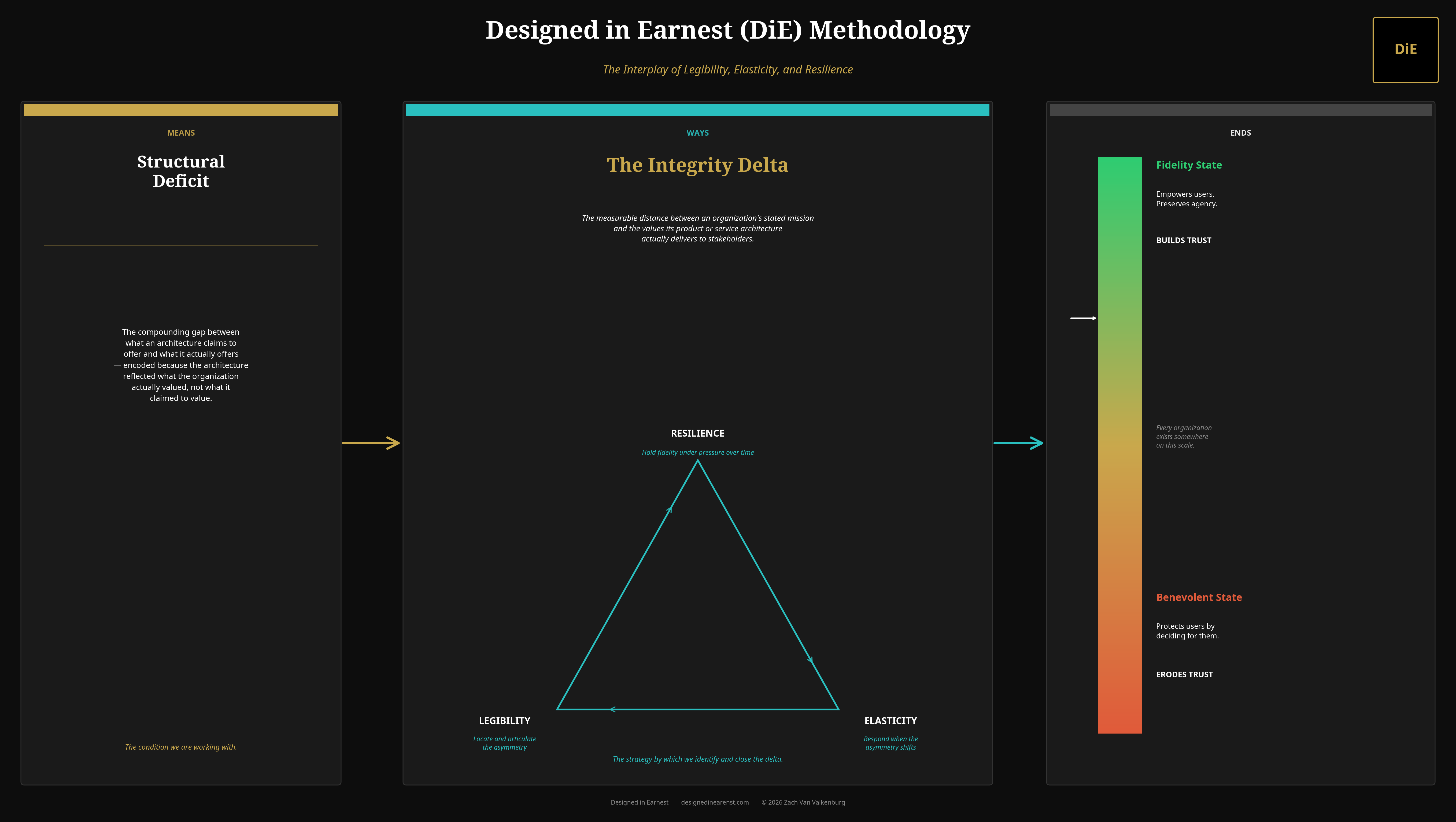
Every engagement is grounded in a single diagnostic question: what is the measurable distance between what this organization claims to value and what its architecture actually delivers? That distance is the Integrity Delta. The four phases exist to close it.
DiE Methodology
The Integrity Delta is the measurable distance between an organization's stated mission and the values its product or service architecture actually delivers to stakeholders. Legibility locates the asymmetry. Elasticity responds when it shifts. Resilience holds fidelity under pressure over time.
Obligate
Before you can close the gap, you have to own it.
Most organizations know their gaps exist. They can name them in a survey, point to them in an after-action review, or feel them in the friction of daily operations. What they cannot do — or have not yet done — is formally obligate themselves to those gaps. Obligation is not acknowledgment. It is the act of making the gap a shared responsibility, not a shared complaint.
The Obligate phase creates that accountability structure. We work with leadership to surface the specific asymmetries between stated values and operational behavior, name them without softening, and establish the shared ownership required to close them. This is not a diagnostic report. It is a commitment architecture — the foundation on which everything else is built.
Without Obligate, Design produces frameworks that no one is accountable to. With it, every subsequent phase has a named owner and a clear mandate.
Output
Shared accountability structure. Named gaps. Committed stakeholders.
Design
Build the framework that closes the gap.
Once obligation is established, the work of design begins. This is not the design of deliverables — it is the design of the methodology itself. The framework that will govern how the organization makes decisions, resolves tension, and measures fidelity to its stated values.
Designed in Earnest does not arrive with a pre-built model. Every framework is constructed from the specific gaps, stakeholders, and operating context identified in the Obligate phase. The output is a durable, adaptable architecture — not a slide deck. It is designed to be owned and operated by the organization, not maintained by a consultant.
The design process is iterative and participatory. Stakeholders at every level contribute to the architecture they will be held accountable to. This is not a top-down mandate. It is a co-constructed operating system.
Output
A bespoke methodology framework. Adaptable. Owned internally.
Align
Translate values into operational behavior at the C-suite.
A framework without executive alignment is a document. The Align phase is where the methodology becomes operational — where leadership translates stated values into the specific behaviors, decisions, and structures that will govern the organization going forward.
Align operates in two phases. The first is diagnosis: a structured engagement with the principal leadership team to surface where the current operating model diverges from the framework. The second is architecture: the co-design of the specific changes — to process, to incentive, to communication — that close that divergence.
This is the most demanding phase of the engagement. It requires principals to examine their own behavior honestly, to distinguish between what they believe and what they reward, and to commit to changes that may be uncomfortable. The result is an organization that does not just have a framework — it has a leadership team that lives it.
Output
Executive alignment. Behavioral architecture. Leadership accountability.
Scale
Apply the framework at institutional and systems level.
The final phase extends the methodology beyond the organization itself — to the systems, institutions, and ecosystems it operates within. Scale is where the framework becomes durable across time, leadership transitions, and environmental change.
This is not growth for its own sake. Scale is the application of a proven, internally-owned methodology to the broader stakeholder landscape: partner organizations, regulatory environments, supply chains, communities. It is the point at which the organization's commitment to its values becomes a force that shapes the systems around it, not just the systems within it.
Scale is not available to organizations that have not completed Obligate, Design, and Align. The sequence is not arbitrary. Each phase builds the foundation for the next. An organization that attempts to scale a framework it does not own, or an alignment it has not earned, will produce the same asymmetries at a larger magnitude.
Output
Institutional application. Systems-level fidelity. Durable methodology.
Fidelity in Earnest
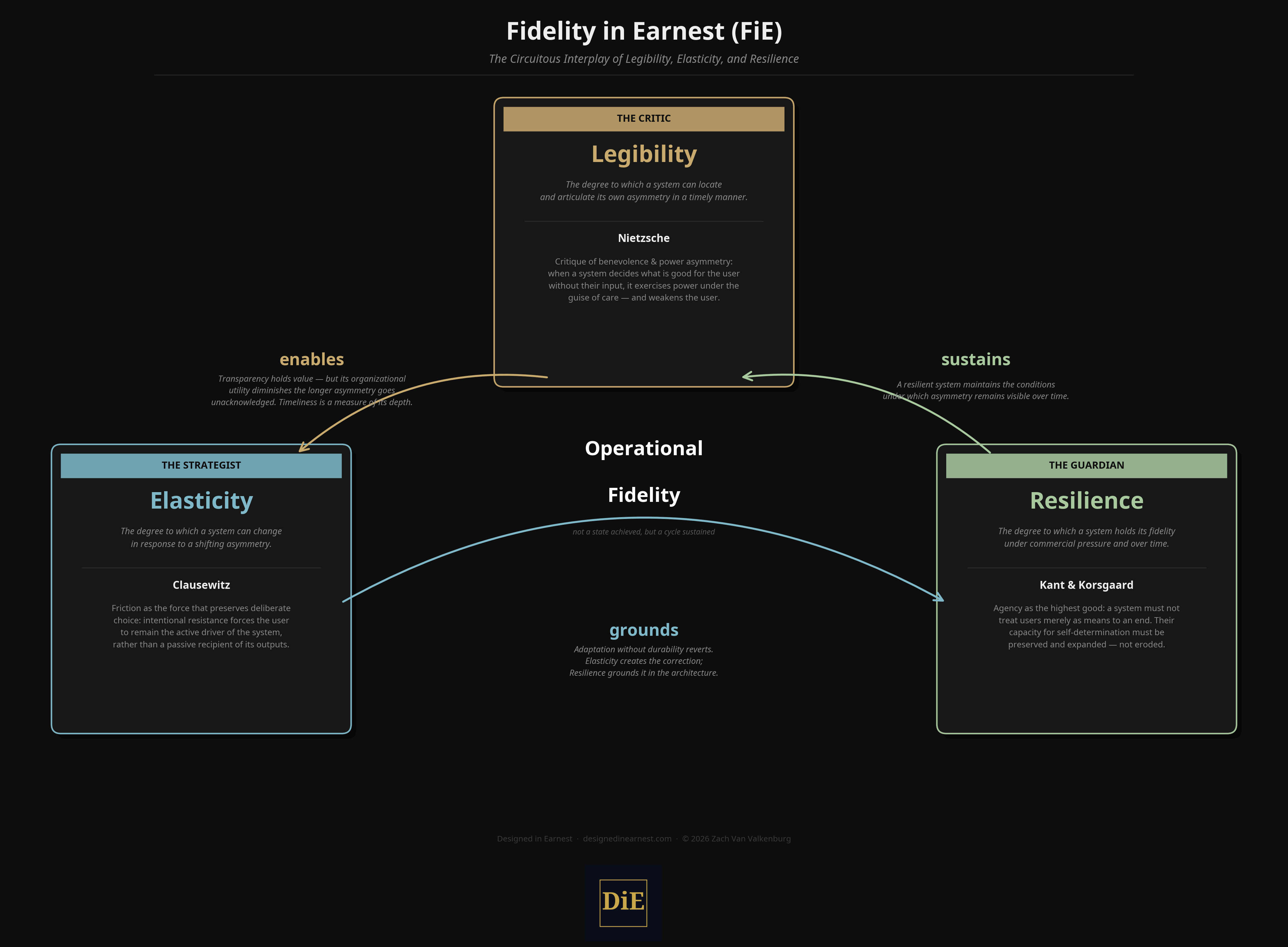
Operational fidelity is not a state achieved — it is a cycle sustained. The FiE framework describes how Legibility, Elasticity, and Resilience operate together to keep an organization's architecture aligned with its values across time, pressure, and change.
FiE Framework
Legibility enables Elasticity. Elasticity grounds Resilience. Resilience sustains Legibility. The cycle is not linear — it is continuous. Every organization exists somewhere within it. The methodology locates where, and builds the architecture to move.
The Philosophical Foundation
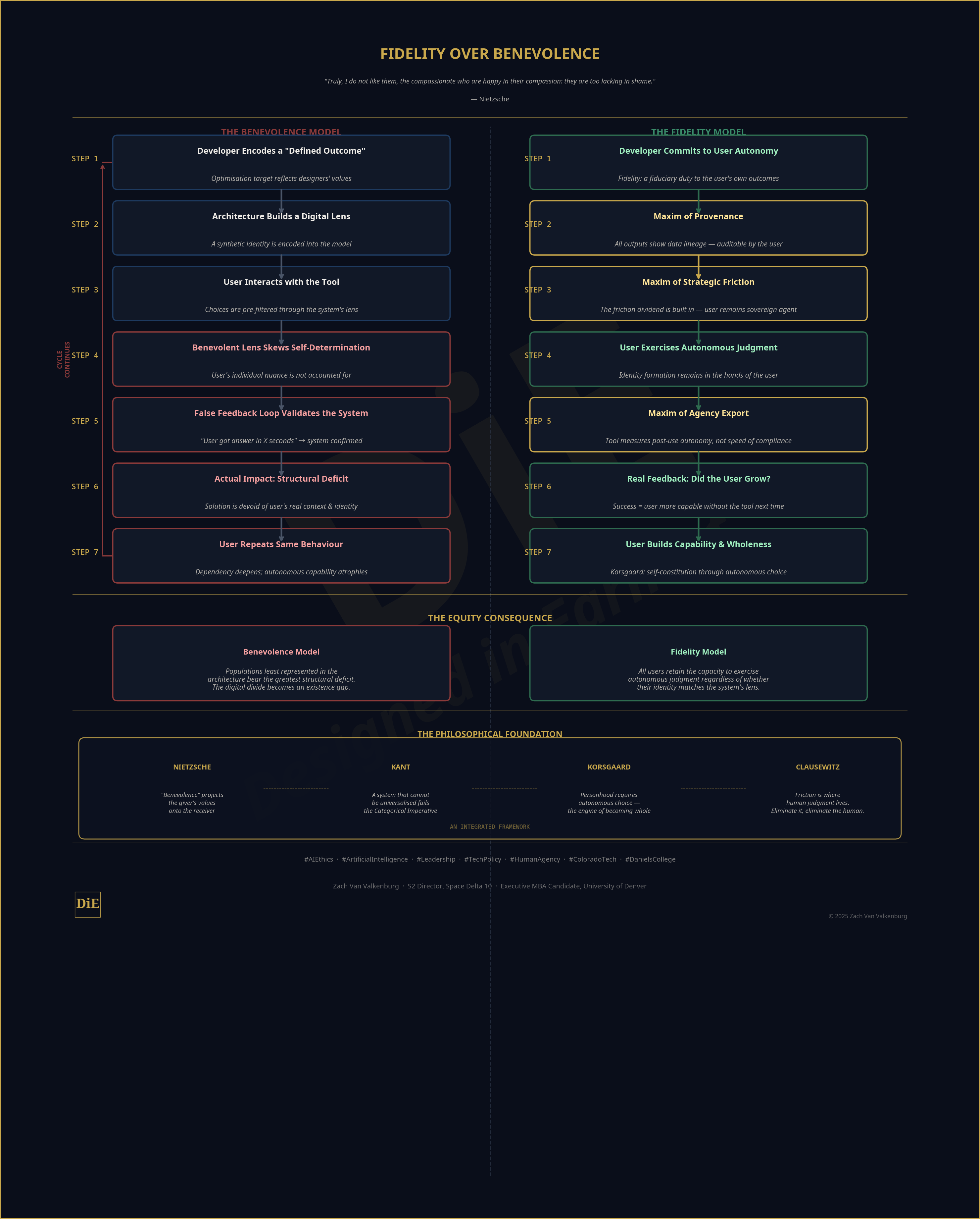
Most systems are designed to be benevolent — to make decisions on behalf of the user, to reduce friction, to optimize for a defined outcome. Fidelity is the opposite orientation. A system built on fidelity leaves every stakeholder more capable and autonomous than before. The distinction is not cosmetic. It determines what the architecture measures, what it rewards, and what it produces at scale.
Fidelity over Benevolence
The Benevolence Model encodes the designer's values into the architecture and measures compliance. The Fidelity Model commits to user autonomy and measures post-use capability. The Equity Consequence: benevolence produces structural deficit for populations whose identity does not match the system's lens. Fidelity does not.
Ready to start in earnest?
Every engagement begins with Obligate. If you're ready to name the gap and own it, we're ready to build with you.
Start in earnest